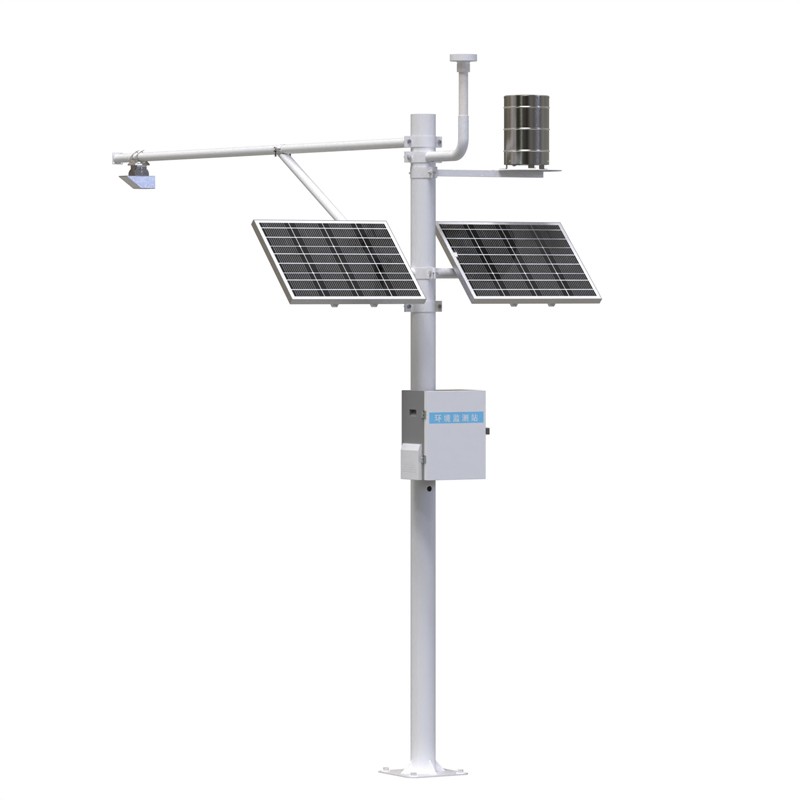
When deploying equipment in remote river channels or mountainous watersheds, manufacturers of water conservancy monitoring equipment often encounter issues where data cannot be transmitted back due to interruptions in public network connectivity. The BeiDou-based hydrological and environmental monitoring station, produced by Shandong Fengtu IoT Technology Co., Ltd., integrates BeiDou short-message communication with radar-based hydrological measurement technology. This provides a transmission pathway for monitoring water levels, flow velocities, and discharge rates in areas lacking signal coverage, without any reliance on terrestrial base stations.
Hydrological monitoring sites are frequently located in remote, rugged areas that lack access to the power grid or fiber-optic infrastructure—environments where conventional wireless transmission methods often struggle to operate reliably. The Fengtu FT-SW4 monitoring station utilizes BeiDou-2 and BeiDou-3 regional short-message services for data transmission. The device sends data packets to a central station at pre-set intervals, eliminating the need for relay through terrestrial base stations. In flash-flood-prone gullies or at control sections in the upper reaches of small-to-medium rivers, this link ensures that essential flood reporting capabilities remain intact, even if heavy rainfall causes public network outages.
Regarding measurement methodology, the device employs planar-array radar antennas to capture water level and flow velocity data through non-contact sensing. Radar-based measurements are unaffected by sediment, floating debris, corrosive substances, or surface foam, and they remain stable despite fluctuations in air temperature or wind speed. By simultaneously collecting flow velocity and water level data—and integrating these with pre-configured cross-sectional parameters—the system calculates the discharge rate. This makes it well-suited for complex hydraulic environments, such as irrigation channels, sewage discharge outlets, and tidal river sections.
The equipment is designed for low power consumption and supports a solar-plus-battery power supply. With an IP68 ingress protection rating, it is built for long-term operation in environments characterized by high humidity, dust, and significant temperature variations. Accompanying configuration software allows on-site personnel to adjust parameters based on the specific geometry of a channel, reducing the need for recalibration when moving between different cross-sections. The system can be deployed simply by mounting it on a pole—eliminating the need for dedicated station structures—making it ideal for temporary monitoring tasks that require rapid setup.
From the manufacturer’s perspective, the engineering value of this product line lies in its ability to bridge the coverage gaps inherent in systems that rely exclusively on terrestrial communication networks. For hydrological monitoring sites where public network signals are unstable or entirely unavailable, the traditional approach has been to rely on manual field surveys—or, in cases where communication infrastructure is inadequate, to forgo establishing a station altogether. The integration of BeiDou short-message communication provides a viable technical solution for continuous data collection at such locations, while also offering manufacturers of water resource monitoring equipment a clear product development direction for markets in areas lacking signal coverage.
This paper addresses:https://www.fengtusz.com/company/1110.html