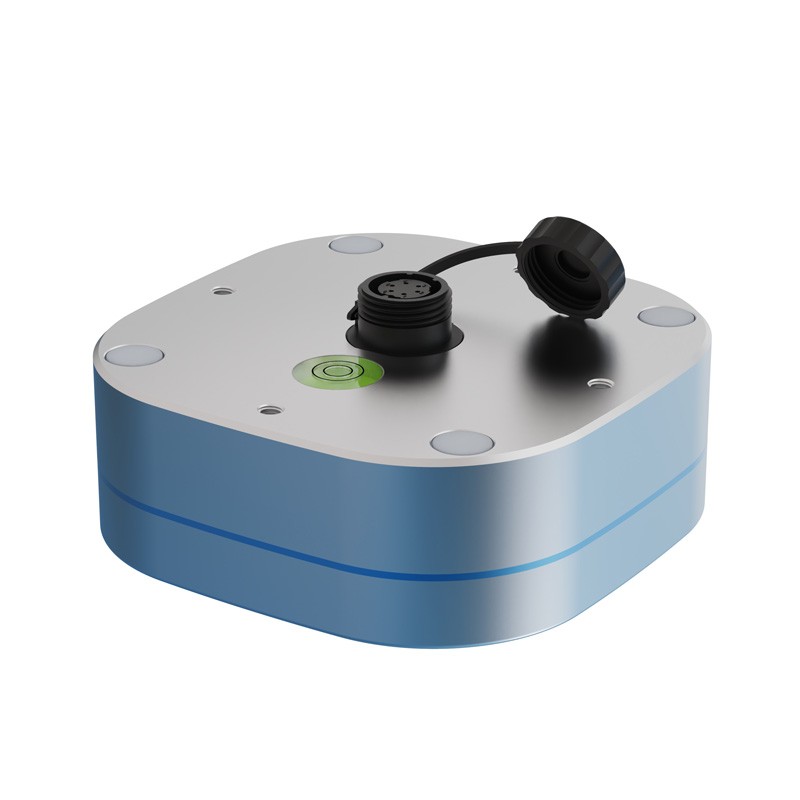
Integrated radar water level gauges utilize Frequency-Modulated Continuous Wave (FMCW) technology, operating within the 76–79.9 GHz frequency band to measure surface water levels without physical contact. Featuring a compact, all-in-one design, these devices offer a beam angle of approximately 10 degrees and a measurement range spanning 0.1 to 40 meters. With an accuracy of ±1 mm, low power consumption, and high resistance to environmental interference, they are well-suited for applications such as water level monitoring in lakes and rivers, flash flood early warning systems, reservoir management, and liquid level monitoring in sewage pipeline networks.
The choice of FMCW technology—as opposed to pulse-based radar—ensures there is no "blind zone" in short-range measurements, allowing for effective detection of water levels as low as 0.1 meters. Operating in the 76–79.9 GHz millimeter-wave band enables a narrow beam, which allows for a smaller antenna size and a more compact overall device footprint. This also enhances directivity, reducing sensitivity to surrounding obstacles during installation. The 10-degree beam angle helps minimize the reception of unwanted echoes (clutter) reflected from objects other than the water surface, such as bridge piers or canal embankments.
In terms of performance, these gauges cover a range of 0.1 to 40 meters with a resolution of 1 mm and an accuracy of ±1 mm. The data refresh rate can be as fast as 40 milliseconds; for a physical parameter like water level—which typically changes relatively slowly—this response speed is sufficient to capture transient fluctuations caused by wind or waves, with internal filtering algorithms then used to output a smoothed water level value.
Environmental adaptability is a key metric for these gauges in real-world deployments. A primary advantage of non-contact measurement is that the sensor does not come into direct contact with the water, thereby avoiding issues such as sediment accumulation, corrosion from wastewater, or entanglement with floating debris. The device operates within a temperature range of -45°C to +85°C and supports a wide input voltage range of 9V to 24V. With a typical operating current of approximately 20mA, it is well-suited for long-term, unattended operation at remote field sites when paired with a solar power system. It features an IP68 ingress protection rating, with an enclosure made of aluminum alloy or stainless steel; the internal circuitry is encapsulated (potted) to ensure reliability in environments such as riverbanks, where high humidity and significant temperature fluctuations are common.
The product’s design parameters are tailored to specific application scenarios. For lake and river monitoring, which require a long measurement range and stable, long-term data output, a 40-meter range is sufficient to cover the water level fluctuations of most small-to-medium-sized rivers. In flash flood early-warning scenarios, the focus shifts to low power consumption and rapid response; the equipment must operate continuously—powered by batteries or solar energy—in remote areas lacking a mains power supply, while ensuring timely data transmission during sudden surges in water levels. In applications involving sewage pipeline networks or reservoirs, where installation space is often constrained, the device’s compact, integrated design offers a clear advantage: it requires no additional stilling wells or large mounting structures, as it can be fixed directly beneath a manhole cover or onto the wall of a reservoir. Furthermore, the product incorporates Bluetooth for configuration and a 4G module for data transmission, significantly reducing the need for on-site wiring and manual debugging.
This paper addresses:https://www.fengtusz.com/industry/1108.html