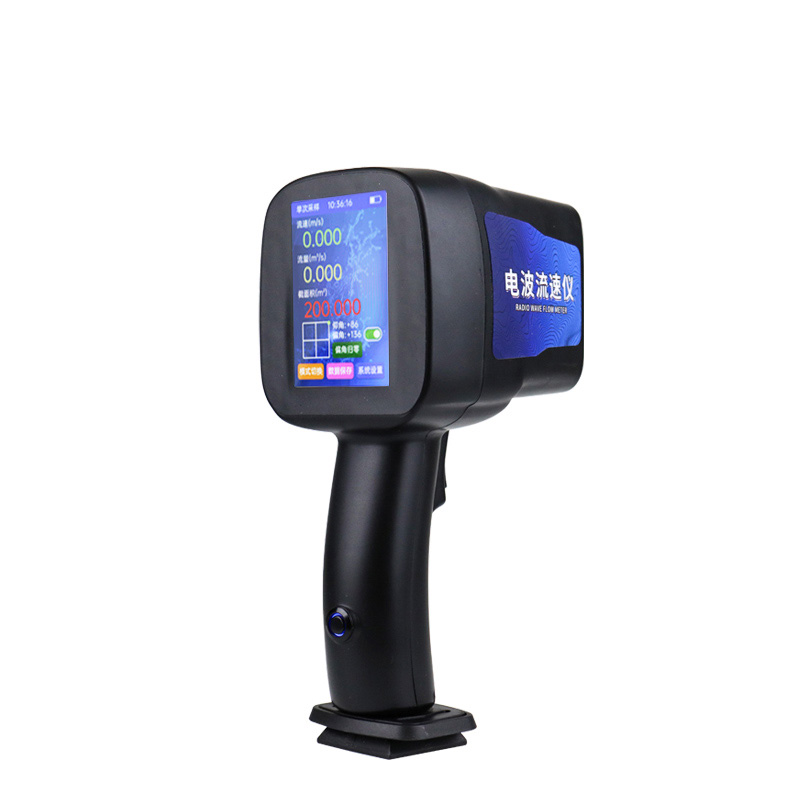
This handheld radar current meter uses K-band radar for non-contact measurement of flow velocity in rivers, sewage, and other water bodies. It is compact, handheld, battery-powered, and easy to use, unaffected by external conditions, and suitable for various scenarios such as field surveys and flood control.
This handheld radar current meter is a device specifically designed for measuring water flow velocity. Its core technology utilizes K-band radar to achieve non-contact flow velocity measurement in various water bodies, including rivers, sewage, mud, and oceans. It accurately acquires flow velocity data without contacting the water, making it suitable for various complex aquatic environments.
This device is characterized by its practicality. Its compact size makes it easy to carry. The handheld design and battery power eliminate the need for an external power source, making it very easy to use and requiring no professional training. Its core advantage lies in its non-contact detection method, detecting surface flow velocity through radio waves. Microwave radar is unaffected by external conditions such as temperature and pressure, allowing it to function stably in complex outdoor environments and enabling measurements to be conducted anytime.
Handheld radar current meters have a wide range of applications, including field surveys, flood control and drainage, and wastewater monitoring, and are particularly suitable for flow velocity monitoring during flood season and emergencies. During flood season, water flow velocity changes rapidly and currents are turbulent. Contact measurements pose safety hazards and are inconvenient to operate. This device can quickly complete measurements on the shore and provide timely feedback on flow velocity data, supporting flood control decisions.
In field surveys, its compact and portable design allows staff to move flexibly between different monitoring points and efficiently complete various water flow velocity monitoring tasks. In wastewater monitoring, measurements can be taken without contact with wastewater, avoiding equipment corrosion and ensuring the safety of monitoring personnel. In complex water environments such as oceans and mud, its strong anti-interference capabilities allow it to accurately capture flow velocity changes, ensuring accurate and reliable monitoring data. With its convenient operation and stable performance, this device has become an ideal tool for outdoor water flow velocity monitoring, meeting the flow velocity measurement needs of different fields and providing strong data support for water conservancy monitoring, environmental management, and other work.
This paper addresses:https://www.fengtusz.com/technical/945.html