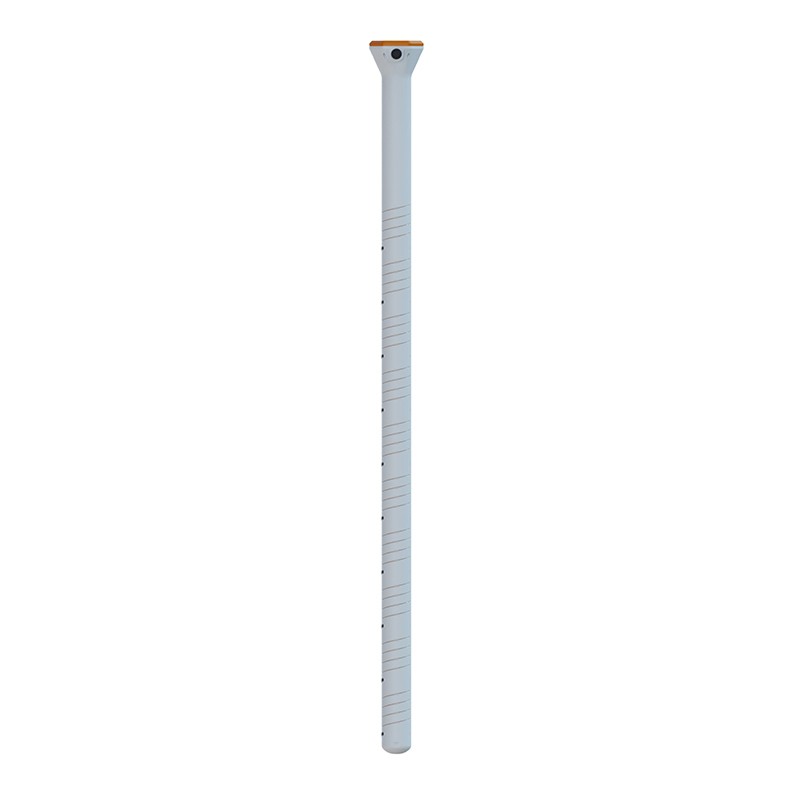
This soil monitoring equipment enables the simultaneous measurement of temperature, moisture, and electrical conductivity across multiple soil profile layers. Utilizing the dielectric constant measurement principle and RS-485 Modbus RTU communication, it delivers stable measurement accuracy. It is well-suited for soil moisture monitoring in agricultural applications such as smart greenhouses, orchards, and smart irrigation systems.
The equipment relies primarily on an integrated sensor to simultaneously capture soil profile temperature, moisture, and conductivity data. It employs the dielectric constant measurement principle and features a helical measurement electrode to determine soil volumetric water content. Capable of simultaneously measuring parameters across up to ten soil depths, it meets the requirements for in-situ monitoring of various soil layers in agricultural fields. The device has a 60-second startup time, operates on 12V DC power, and features low power consumption (0.26W total power, 22mA operating current). It utilizes the RS-485 Modbus RTU protocol for data output, facilitating easy integration with various agricultural data loggers and host systems, making it ideal for long-term field burial and continuous data collection.
Regarding measurement performance, the equipment offers a soil temperature measurement range of -30°C to 70°C, with an accuracy of ±0.3°C (within the -10°C to 70°C range) and a resolution of 0.01°C. The soil moisture measurement range is 0–100%, with an accuracy of ±3% in loam environments (and the capability for targeted calibration in high-organic-matter or high-clay soils) and a resolution of 0.1%. The soil electrical conductivity range is 0–20,000 µS/cm, with an accuracy of ±3% (up to 10,000 µS/cm) and ±5% (full range), and a resolution of 1 µS/cm. It accurately reflects soil moisture and salinity fluctuations, providing raw, measured data to support crop management decisions. Such soil monitoring equipment is widely deployed in agricultural sectors—including smart greenhouses, smart orchards, and smart irrigation systems—enabling personnel to utilize multi-layer soil profile data to accurately assess the moisture, temperature, and salinity levels within the root zone. This allows for the optimization of irrigation frequency and volume, thereby minimizing water waste and mitigating the risk of soil salinization. Once buried, the devices provide continuous data output without the need for frequent sampling, effectively reducing the time and labor costs associated with manual on-site testing. During selection and implementation, it is essential to account for variations in soil composition; for plots with high organic matter or clay content, device calibration can further enhance data reliability, ensuring the effectiveness of data utilization in smart agriculture projects.
This paper addresses:https://www.fengtusz.com/industry/1095.html