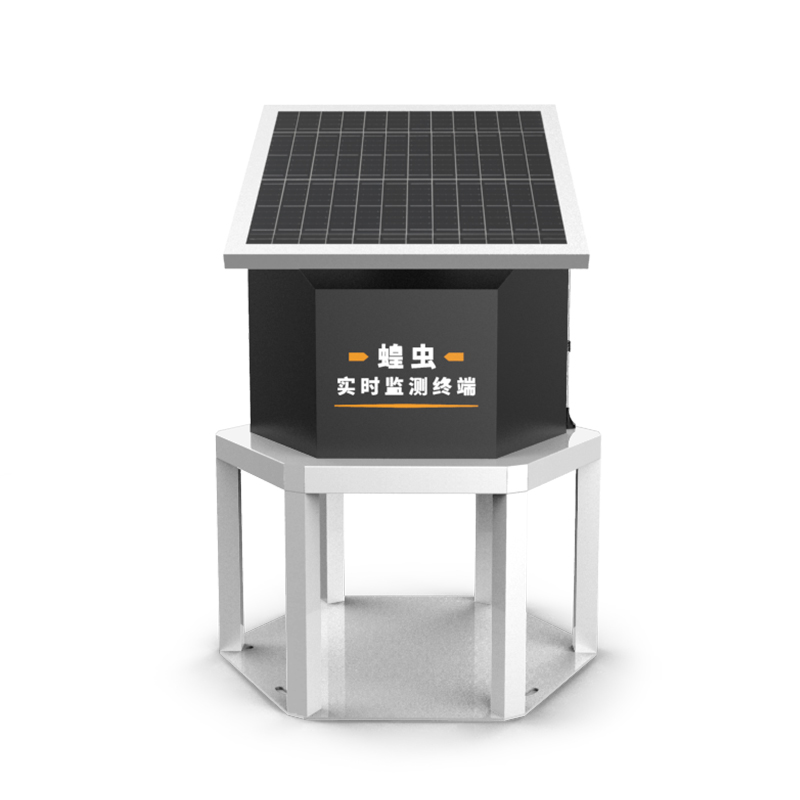
Locust online monitoring station is a physical control device used to monitor and control locust populations. It attracts and captures locusts using specific light sources or sex pheromones, enabling the analysis of population dynamics and reduction of local locust density, thus supporting locust plague early warning and green control.
The core function of Locust online monitoring station is trapping and monitoring. Its working principle is mainly based on two attraction methods. One is light attraction, utilizing the phototaxis of locusts; the device releases light of specific wavelengths (such as ultraviolet light or LED light of a specific spectrum) to attract adult locusts. The other is sex attraction, which uses artificially synthesized female locust sex pheromones to lure male adults into the trap. Some advanced devices employ a "dual-light attraction" system, which can switch between two different wavelengths of light at regular intervals to address the differences in locust species or their day-night activity habits, improving trapping efficiency.
The captured locusts serve two main purposes. Firstly, direct physical control involves capturing large numbers of adult locusts to directly reduce their mating rate and local population size, mitigating immediate damage to crops. Secondly, the crucial monitoring and early warning function is implemented. Agricultural technicians regularly collect captured locusts and analyze key biological parameters such as species composition, population density, sex ratio, and instar (nymph to adult ratio). This data is the core basis for predicting locust swarm development stages, migration trends, and outbreak risks, providing scientific support for determining the timing and scale of control measures.
In practical deployment, the application of Locust online monitoring station has specific scenarios. It is widely used in long-term fixed-point monitoring stations in potential locust areas, forming an early warning network. Deployment in agro-pastoral transition zones, grasslands, and farmland edges allows for routine population monitoring. When a significant increase in locust population density is detected in a certain area, a large number of traps can be urgently deployed as a pre-emptive control measure or auxiliary means of reducing the locust population before large-scale chemical pesticide spraying, especially suitable for ecologically sensitive areas or organic farms to reduce the use of chemical pesticides.
Several key points should be noted for the effective use of Locust online monitoring station. Deployment locations should be chosen in locust-preferred habitats or migration routes, such as open grasslands and farmland ridges. The devices require regular cleaning and maintenance to ensure the effectiveness of the attractant (light or lure). For monitoring purposes, standardized survey sampling frequencies and data recording methods must be strictly followed to ensure the continuity and comparability of information. It should be noted that this equipment is better suited for monitoring and sustained suppression of low-density locust populations. For large-scale, high-density migrating locust swarms, it should still be used as part of an integrated pest management system in conjunction with other methods.
Currently, the technological development of Locust online monitoring station focuses on intelligentization and data integration. The new equipment is equipped with solar panels, automatic counting sensors, image recognition cameras, and wireless transmission modules, enabling unattended, remote, real-time transmission of population data to the monitoring platform, significantly improving the timeliness of early warnings. As an environmentally friendly plant protection tool, Locust online monitoring station plays an important role in promoting sustainable locust control and protecting agricultural ecological security.
This paper addresses:https://www.fengtusz.com/industry/900.html