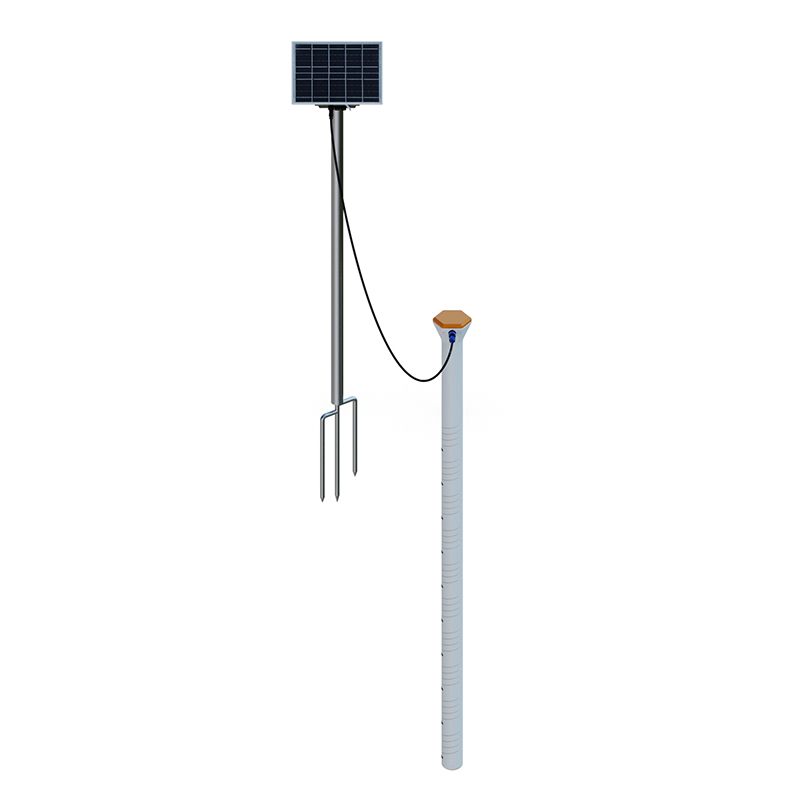
TDR soil moisture monitoring stations utilize Time Domain Reflectometry (TDR) to measure soil profile temperature, moisture, and electrical conductivity. By transmitting data via Low-Power Wide-Area Networks (LPWAN) and integrating with meteorological and crop growth models, these stations automatically generate irrigation recommendations, making them ideally suited for applications in the field of smart agriculture.
TDR-based soil moisture monitoring stations are primarily designed for agricultural engineering scenarios—such as smart greenhouses, smart orchards, and smart irrigation systems—where they are used to continuously monitor soil profile temperature, moisture, and electrical conductivity in real time. TDR technology works by measuring the propagation time of electromagnetic waves through the soil to derive the dielectric constant, thereby calculating the volumetric water content. Compared to Frequency Domain Reflectometry (FDR), TDR is less susceptible to interference in regions with high soil salinity, offering a monitoring accuracy superior to ±2%. Conversely, FDR boasts faster response times and lower power consumption, with errors controllable within ±1%. Some devices integrate both TDR and FDR technologies simultaneously, allowing users to select the most appropriate measurement method based on specific soil types and environmental conditions.
A core advantage of the TDR soil moisture monitoring station lies in its layered monitoring capability. A single tubular sensor can simultaneously measure soil parameters across 3 to 10 distinct depth layers; with a minimum measurement interval of just 10 centimeters between points, the system is capable of generating a complete soil moisture profile. Each sensor layer independently outputs values for soil temperature, moisture, and electrical conductivity, achieving a temperature accuracy of ±0.3°C, a moisture accuracy of ±3%, and a conductivity measurement range of 0 to 20,000 µS/cm. The device is powered by a combination of solar energy and an internal lithium battery, consuming a mere 0.26 watts of power. With an IP67 waterproof rating, it is designed to operate autonomously and unattended in rugged outdoor environments for extended periods.
Data is transmitted via an RS485 interface using the Modbus RTU protocol, while simultaneously leveraging LPWAN technology to upload monitoring data to a cloud-based platform in real time. In a digital twin demonstration project located within the Shule River Basin in Gansu Province, the soil moisture stations successfully achieved continuous monitoring of water content and temperature within the 0–30 cm soil layer. This data was instantly transmitted via a 4G network to a digital twin platform, where it was integrated with multi-source data—including temperature, humidity, wind speed, and solar radiation—collected by meteorological stations. This comprehensive dataset is subsequently utilized to construct intelligent irrigation models and optimize drip irrigation strategies. The system's application scenarios have expanded to encompass water-saving irrigation in high-standard farmland, optimized water distribution in irrigation districts, drought forecasting, and the monitoring of crop growth conditions and potential hazards. This enables managers to remotely guide field operations such as irrigation, fertilization, and pesticide application. By setting specific soil moisture thresholds, the system can automatically trigger warning notifications, thereby supporting agricultural irrigation decision-making and the development of crop growth models.
This paper addresses:https://www.fengtusz.com/industry/965.html