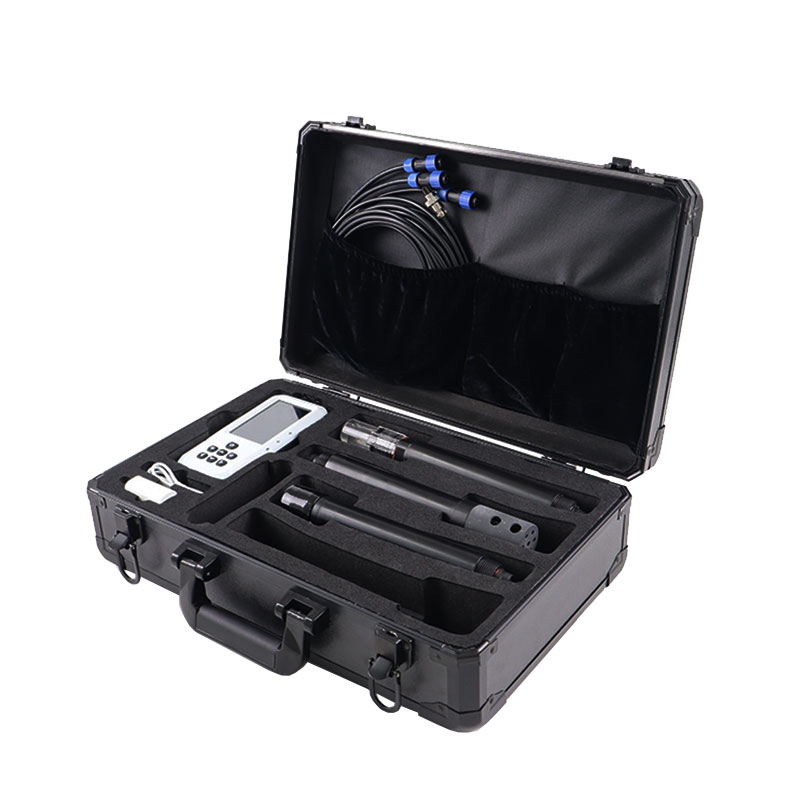
Water Flow Monitor consists of a Doppler current meter, data acquisition unit, communication network, and software platform. Based on the ultrasonic Doppler principle and the velocity-area method, it achieves high-precision measurement of flow velocity and flow rate without the need for weirs or flumes, significantly reducing construction costs.
Water Flow Monitor is an automated facility specifically designed for monitoring the flow rate of open channels such as rivers, irrigation canals, and reservoir spillways. The system mainly consists of four parts: a Doppler current meter, a data acquisition unit, a communication network, and a software platform. The Doppler current meter is divided into a sensor and a main unit, responsible for collecting raw flow velocity data in natural water bodies.
The core working principle of Water Flow Monitor is based on the Doppler effect and the velocity-area method. The system emits ultrasonic waves through the Doppler current meter and receives the frequency shift signals generated by impurities or bubbles in the water flow, thereby calculating the precise flow velocity with an accuracy error controllable within ±1% FS. Simultaneously, the equipment utilizes pressure sensors to measure real-time water levels and automatically calculates the flow cross-sectional area based on a preset channel cross-sectional shape. Finally, it derives the instantaneous and cumulative flow rates using the formula "flow rate equals flow velocity multiplied by area." This process eliminates the need for weirs, significantly reducing civil engineering costs and avoiding the impact of weir construction on the existing water flow conditions.
In terms of installation and deployment, Water Flow Monitor is highly flexible and adaptable. The system supports optional configurations of Doppler current meters or radar velocity sensors, enabling non-contact measurement to handle complex water bodies with high sediment content or abundant floating debris. The equipment incorporates multiple cross-sectional models, including circular, rectangular, and trapezoidal shapes, facilitating convenient debugging and rapid switching between different channel structures. The communication module supports 4G/BeiDou dual-mode transmission, allowing real-time data reporting to the monitoring center platform. Data can be remotely viewed via mobile phones and PCs, achieving unattended automated operation.
Water Flow Monitor plays a crucial role in water resource allocation, irrigation district information management, ecological flow monitoring, and urban drainage monitoring. With its low-power design, the device operates at a current of less than 25mA, enabling it to operate in the field for extended periods in conjunction with a solar power system. This meets the water resources department's needs for continuous hydrological data collection and remote monitoring, providing reliable technical support for refined watershed management and optimized water resource allocation.
This paper addresses:https://www.fengtusz.com/technical/989.html